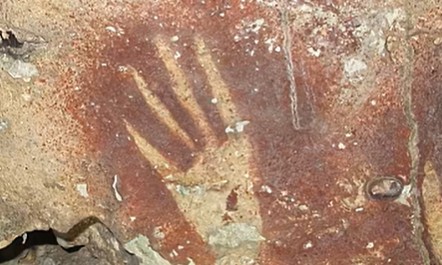
Rock art from at least 67,800 years ago in Sulawesi
ARC Centre of Excellence for Transforming Human Origins Research
This research forms part of the Transforming Human Origins Research ARC Centre of Excellence, a seven-year international research program based at Griffith University and led by Professor Michael Petraglia.
The Centre brings together researchers across multiple Australian universities and international partner institutions to integrate Indigenous knowledge, cutting-edge science, and global collaboration. Its work focuses on reshaping understanding of human origins, creativity, migration, and cultural expression across deep time, through close collaboration with communities in Africa, Asia, and Australia.
The Centre is one of only eight ARC Centres of Excellence funded nationally, and the first dedicated to transforming scientific understanding of human origins.
It brings together 62 researchers across eight Australian universities, working with 30 international partners to integrate Indigenous knowledge, cutting-edge science, and global collaboration.
The Centre supports:
-
more than 40 research fellows,
-
70 PhD and Masters students, and
-
112 Honours students,
with half of all opportunities prioritised for Indigenous researchers and scholars from the Global South.
Research teams work with communities in Africa, Asia, and Australia, co-designing research that reshapes understanding of innovation, adaptation, and heritage across deep time.
Rock Art Australia is proud to be part of this global effort and partnership.
For more on the project, including the list of key people, and partners, click on the orange button below.